


Intel returns to boxed workstation CPUs with Xeon 600 — Granite Rapids WS delivers up to 86 cores, 4TB of memory, and 128 PCIe 5 lanes
After nearly three years, Intel is returning to the desktop workstation with the hotly-anticipated (and long-rumored) Granite Rapid-WS series. Now known as Xeon 600, the new series covers all of Intel's bases for desktop workstations. With previous-gen Sapphire Rapids-WS, Intel split its offerings between two different lineups — Xeon W-2500 and Xeon W-3500 — but all Granite Rapids workstation chips will live under the same Xeon 600 branding.
Granite Rapids has been deployed in the data center for about a year and a half, and in that time, AMD introduced its Zen 5-based Threadripper 9000 chips, leaving an open spot in the market for Intel to release its next-gen workstation CPUs. In total, Intel has 11 SKUs for Xeon 600, five of which will show up as boxed models for individual retail sale. Intel hasn't provided a firm release date for the CPUs yet, but it says new W890 motherboards and systems from brands like Dell, Lenovo, Supermicro, and Puget will be available starting in late March.
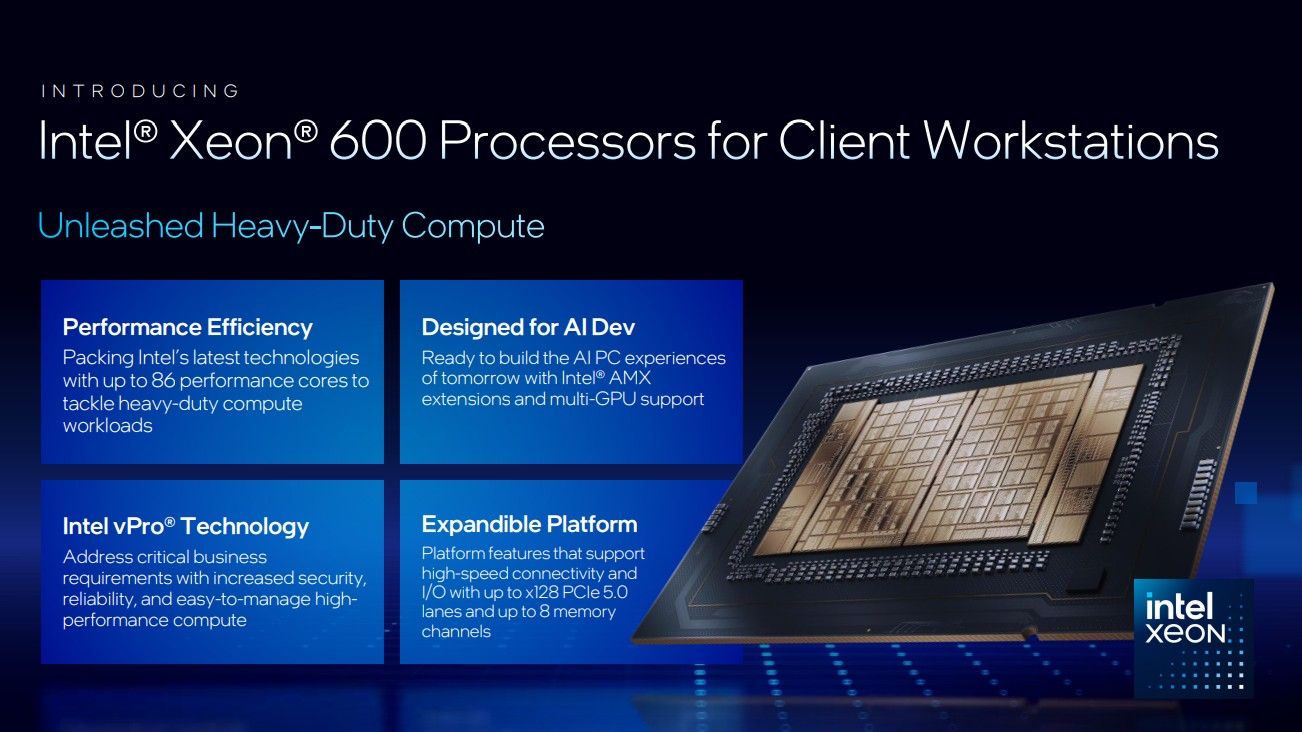
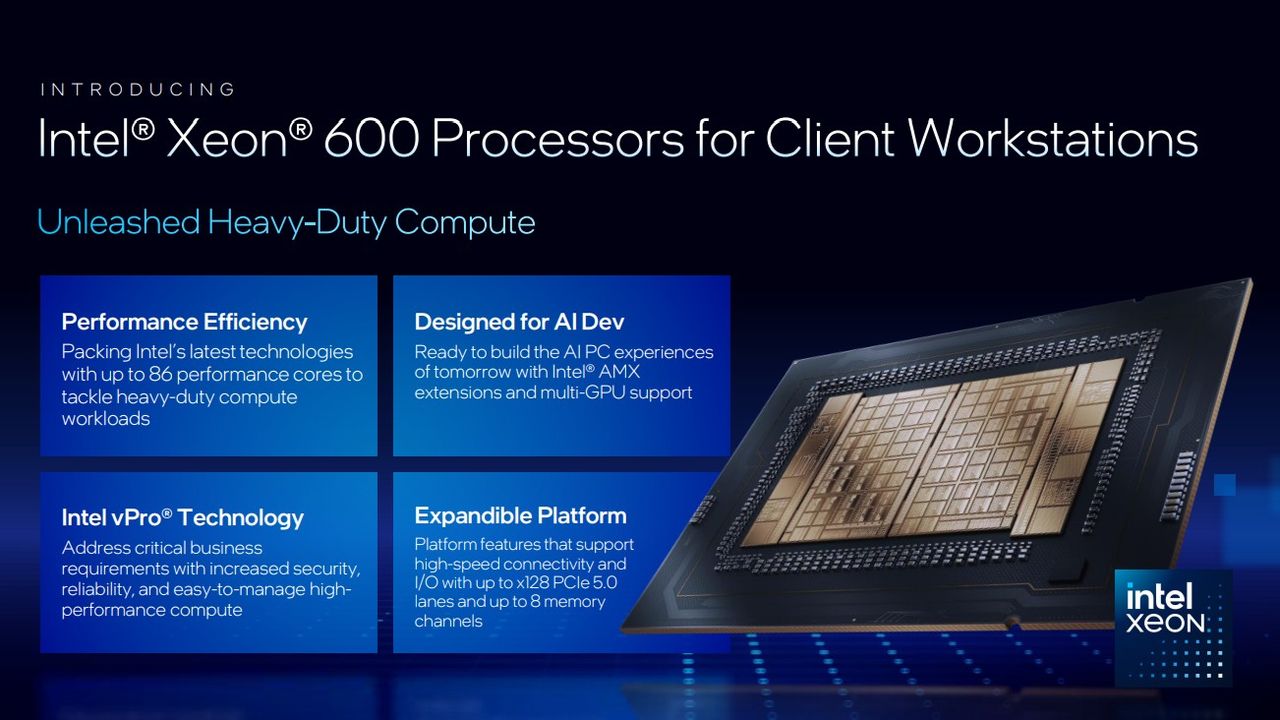
Compared to refreshed Sapphire Rapids-WS parts, Intel broadly claims Xeon 600 delivers up to 9% better single-threaded performance and up to 61% higher multi-threaded performance. The latter metric is explained by much higher core counts on Xeon 600 chips. The previous-gen flagship, the Xeon w9-3595X, topped out at 60 cores. Now, Intel has two SKUs that go above that mark, with the Xeon 698X sporting 86 cores and the Xeon 696X coming in at 64 cores.
Like its data center counterpart, Xeon 600 chips use the Redwood Cove microarchitecture that first debuted in Intel's Meteor Lake mobile chips. Here, the core counts are massively scaled up, however, and keeping with Intel's new split of Xeons with a heterogeneous architecture, Xeon 600 CPUs exclusively use P-cores with Hyper-Threading.
Intel Xeon 600 ‘Granite Rapids-WS' specs
| Row 0 – Cell 0 |
698X |
696X |
678X |
676X |
674X |
658X |
656 |
654 |
638 |
636 |
634 |
|
Cores / Threads |
86 / 172 |
64 / 128 |
48 /96 |
32 / 64 |
28 / 56 |
24 / 48 |
20 / 40 |
18 / 36 |
16 / 32 |
12 / 24 |
12 / 24 |
|
Frequency (Base / Boost) |
2 GHz / 4.8 GHz |
2.4 GHz / 4.8 GHz |
2.4 GHz / 4.9 GHz |
2.8 GHz / 4.9 GHz |
3 GHz / 4.9 GHz |
3 GHz / 4.9 GHz |
2.9 GHz / 4.8 GHz |
3.1 GHz / 4.8 GHz |
3.2 GHz / 4.8 GHz |
3.5 GHz / 4.7 GHz |
2.7 GHz / 4.6 GHz |
|
All-core Turbo |
3 GHz |
3.5 GHz |
3.8 GHz |
4.3 GHz |
4.3 GHz |
4.3 GHz |
4.5 GHz |
4.5 GHz |
4.5 GHz |
4.5 GHz |
3.9 GHz |
|
L3 Cache |
336MB |
336MB |
192MB |
144MB |
144MB |
144MB |
72MB |
72MB |
72MB |
48MB |
48MB |
|
Base TDP |
350W |
350W |
300W |
275W |
270W |
250W |
210W |
200W |
180W |
170W |
150W |
|
Memory channels |
8 |
8 |
8 |
8 |
8 |
8 |
8 |
8 |
4 |
4 |
4 |
|
MRDIMM Support |
8000 MT/s |
8000 MT/s |
8000 MT/s |
8000 MT/s |
8000 MT/s |
— |
— |
— |
— |
— |
— |
|
PCIe 5.0 Lanes |
128 |
128 |
128 |
128 |
128 |
128 |
128 |
128 |
80 |
80 |
80 |
|
Boxed |
— |
Yes |
Yes |
Yes |
— |
Yes |
— |
Yes |
— |
— |
— |
|
Suggested Price |
$7699 |
$5599 |
$3749 |
$2499 |
$2199 |
$1699 |
$1399 |
$1199 |
$899 |
$639 |
$499 |
Above, you can see the full list of Xeon 600 SKUs, which range from $499 for the 12-core Xeon 634 up to $7,699 for the flagship Xeon 698X. Note the five SKUs that will be available individually in boxed retail units. Intel says all SKUs will be available in tray, but the boxed lineup tops out at the 64-core Xeon 696X. The split largely mirrors AMD and how it's treated Threadripper 9000 chips, with the main range topping out at 64 cores, but the Threadripper Pro 9000 WX range climbing up to 96 cores.
Short of the bottom three SKUs, there are some platform features that are consistent across the Xeon 600 range. X-series SKUs are unlocked for overclocking, and they all support octa-channel memory with officially sanctioned speeds up to 6,400 MT/s. You also get 128 PCIe 5.0 lanes, CXL 2.0 support, and Intel's AMX accelerator in each CPU core, which now supports FP16 instructions. The chips also support up to 4TB of memory, doubling what's available on AMD's Threadripper 9000 WX range and quadrupling support compared to the base Threadripper 9000 range. Granted, even a 1TB kit of DDR5-6400 RDIMMs will run you about $28,000 right now.
MRDIMMs use the same physical connector as RDIMMs, so they drop into existing connectors (assuming the CPU supports MRDIMMs). The applications of MRDIMMs are really only relevant in HPC settings where memory bandwidth is critical, and as such, Intel isn't supporting MRDIMMs across the full stack. They're only supported with the top five SKUs, starting at the Xeon 674X.
Intel's Xeon 600 ‘Granite Rapids-WS' performance claims
Intel broadly claims a 9% improvement in single-threaded performance and 61% improvement in multithreaded performance with Xeon 600 compared to Xeon W-2500 and Xeon W-3500. According to Intel, those numbers come from scores in Cinebench 2026, as you can see in the disclaimers and configurations we included at the end of the gallery below.
Looking at SPEC Workstation 4, Intel says the flagship Xeon 698X offers a 17% improvement in AI, 22% in the energy subcategory, 61% in financial services, 19% in life sciences, and 10% in media and entertainment compared to the Xeon w9-3595X. In the productivity category, the Xeon 698X posted identical performance, while in product design, it showed an undisclosed regression.
In specific apps, Intel says the Xeon 698X finished the Blender Junkshop render 74% faster than the Xeon w9-3595X, as well as sped up AI-powered upscaling with Topaz Labs Video Upscaler by 29%. Intel attributes the latter speed up to the AMX accelerators inside Xeon 600 cores. To that end, Intel is introducing Open Image Denoise 2.4, which it says is accelerated by FP16 instructions available in the Xeon 600 AMX.
In development, data analysis, and AI, Intel claims 24% better linear algebra performance (as measured in algorithms in Intel's fork of NumPy/SciPy), 18% faster large dataset analysis with SPEC Workstation 4's data science workload, and 16% faster AI inference with SPEC Workstation 4's ONNX inference test.
Hopefully, we'll have those comparisons soon. Intel says Xeon 600 motherboards with the W890 chipset will launch in late March, as will workstations from OEMs like Dell, Lenovo, and Supermicro. We still haven't learned about a firm release date, nor a release window for boxed Xeon 600 chips.
Follow Tom's Hardware on Google News, or add us as a preferred source, to get our latest news, analysis, & reviews in your feeds.