



These are the recent maximum drawdowns for a handful of giant technology stocks:
- Oracle -46%
- Meta -25%
- Netflix -30%
- Nvidia -17%
- Broadcom -21%
- AMD -25%
Sans Netflix, these are some of the biggest names in the AI trade. This is what everyone has been worrying about for quite some time now.
What happens when the AI trade unwinds?
These companies are worth a combined ~$9 trillion in market cap. Surely the stock market is falling right?
No (and don't call me Shirley).
The S&P 500 is within spitting distance of new all-time highs:
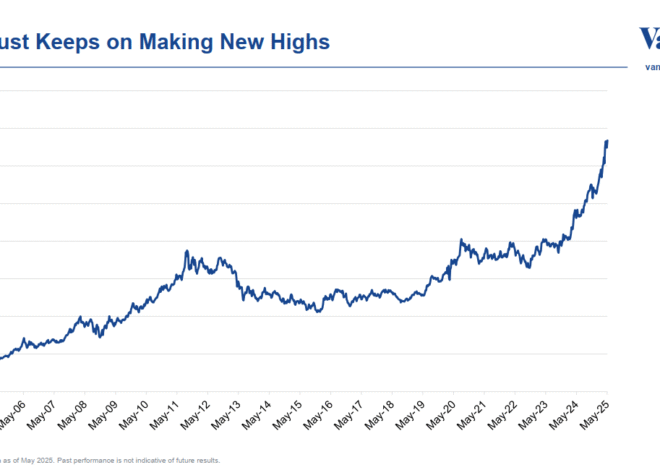
The equal-weighted S&P 500 hit new all-time highs this week:
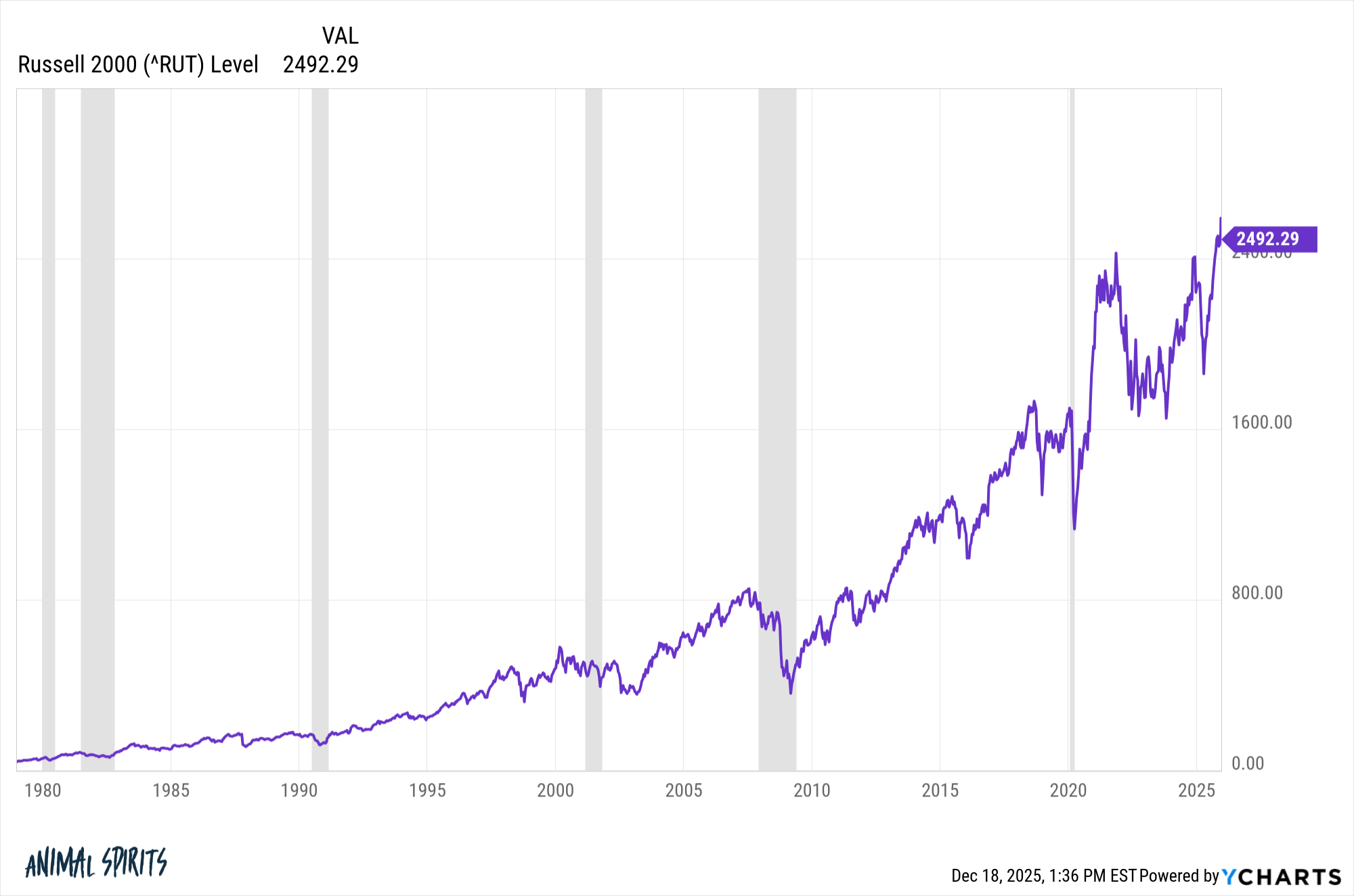
So did the Russell 2000 Index of small cap stocks:
Stock market concentration has been a worry for certain market pundits for years now.
Just wait until the tech stocks rollover. The market is going to get crushed!
Maybe that will happen someday, but these things are fluid. If tech stocks do falter it's also possible other parts of the market will fill the void. That's exactly what's happening right now.
I don't spend much time worrying about stock market concentration because that's how the stock market works. The long-term gains tend to be driven by a small handful of winners.
I'm more concerned about investors who have allowed their portfolios to become overly concentrated during this epic bull market run.
There's an old saying: you concentrate to get rich, but diversify to stay rich.
I've certainly seen that play out with many of the wealth management clients we work with at Ritholtz. There are plenty of people who come to us in search of financial advice who struck it rich through business ownership, real estate investing, company stock options or buying and holding a small number of individual stocks over the long haul.
In the past 5 years or so the number of people with concentrated stock market gains has grown by leaps and bounds.
Here's a story in The Wall Street Journal about an investor who concentrated his portfolio in tech stocks for the past decade and won:
Brian Hahn had most of his savings in tech stocks for a decade. As an escalating artificial-intelligence frenzy this year sent markets to new heights, he sold it all.
The 51-year-old math teacher for years had about 80% of his investments in tech, including exchange-traded funds and individual semiconductor companies. In October, he put most of that money into gold, which many see as a haven during big market downturns.
“It was too much risk for me to assume that this was going to keep moving higher,” said Hahn.
Good for him.
He likely made a bunch of money in tech stocks and has now downshifted into gold. Will this shift work? Time will tell.
Here's my concern for investors like this who concentrated their money in a handful of tech names over the past 5-10 years and destroyed most professional money managers in the process — it's not always going to be this easy.
Obviously, saying this was easy is hindsight bias, but all you had to do was buy a handful of the biggest name-brand companies in the world that create products and services used by billions of us every single day. And you made massive returns in the process!
Buy-what-you-know is not going to work forever.
Dom Cooke wrote an excellent profile at Colossus about Henry Ellenbogen, a former T. Rowe Price portfolio manager who has studied the biggest compounders over the years. This part was interesting:
“We never felt money was going to be free forever,” he said. “But we had made some simplifying assumptions after a decade of free money.”
Ellenbogen is not reactive. He trades his portfolio as little as possible. But by the beginning of 2022, it became clear this wasn't a temporary dislocation. The regime had changed. He went back to his study on compounders. In a normal decade, about 40 stocks compound wealth at 20% a year. In the free money era, 120 stocks had achieved it. There were imposters in his portfolio.
So three times as many companies compounded at 20% per year than normal. This might be a once-in-a-lifetime cycle for huge compounders.
In fact, I would be shocked if we ever saw a situation like this again.
The stock market is concentrated at the top but there are still plenty of other stocks that can soften the blow when the biggest names stumble.
But if you have an ultra-concentrated portfolio of stocks there is no cushion if things go wrong.
Concentration can make you rich, and it has made a lot of people rich in this cycle.
But it can also take away those gains or make you poor in a hurry.
Diversification is going to matter again at some point.
Michael and I talked about stock market concentration, the AI reversal, new all-time highs and more on this week's Animal Spirits video:
Subscribe to The Compound so you never miss an episode.
Further Reading:
The New Normal of Stock Market Concentration
Now here's what I've been reading lately:
Books: